
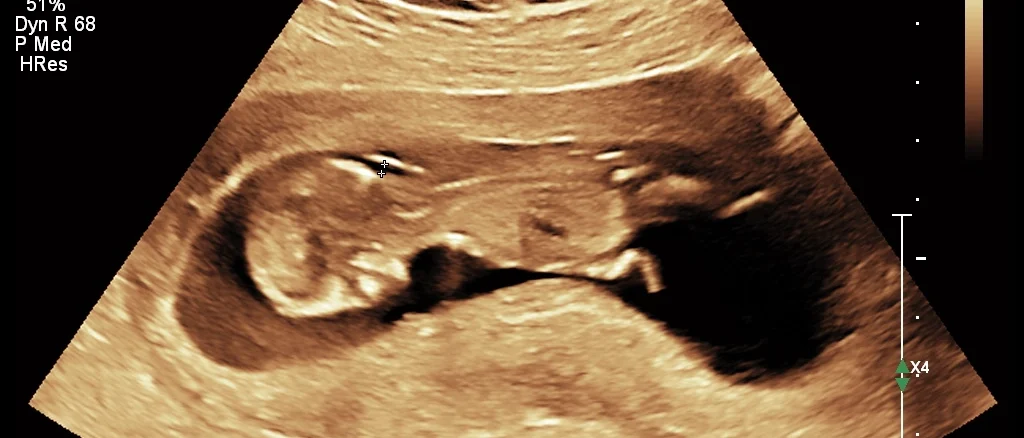
What Does the First-Trimester Screening Assess?
Somewhere around the 11-to-14-week mark of a pregnancy, most obstetricians order a scan that goes by several names — NT scan, NT/NB scan, first-trimester screening scan, or simply “the 12-week scan.” It’s often the first ultrasound where the baby actually looks like a baby on the screen, which makes it an emotional appointment. It’s also, technically, one of the more precise measurements taken in the entire pregnancy, and a small amount of confusion about what the numbers mean is extremely common.
What NT and NB actually stand for
NT is the nuchal translucency — a small, fluid-filled space at the back of the fetal neck, visible on ultrasound in every fetus at this stage of development. NB is the nasal bone — whether it is present and ossified (visible as a bright white line on ultrasound) at this point in gestation. Both are measured on the same scan, and both are used together, alongside a maternal blood test, to calculate a risk score for certain chromosomal conditions, most notably trisomy 21 (Down syndrome), trisomy 18 (Edwards syndrome), and trisomy 13 (Patau syndrome).
Neither NT thickness nor nasal bone absence is, by itself, a diagnosis of anything. They are risk markers — pieces of a probability calculation, not a yes/no test.
Why this has to happen between 11 and 14 weeks
The timing is unusually strict compared with other pregnancy scans, for a specific biological reason: the nuchal fluid pad that’s being measured is a normal, transient feature of fetal development. It tends to be present and measurable in this narrow window and then reabsorbs as the fetal lymphatic system matures. Measure too early (before the crown-rump length reaches roughly 45 mm) and the space may not be reliably visible; measure after about 14 weeks (crown-rump length beyond roughly 84 mm) and the translucency has typically resolved, making the reading meaningless. This is also why the scan is dated by the crown-rump length (CRL) taken on the same visit, rather than by the mother’s last menstrual period — it needs to be precise to the day for the measurement to be interpretable.
Beyond chromosomes: what else a thickened NT can signal
This is a detail that surprises a lot of patients: increased nuchal translucency isn’t only a chromosomal marker. Even in a fetus with normal chromosomes, a significantly thickened NT is associated with a higher background risk of congenital heart defects and certain other structural anomalies. Because of this, when NT is notably increased but chromosomal testing comes back normal, most protocols recommend a detailed fetal echocardiogram and a thorough anomaly scan later in pregnancy, specifically to look more closely at cardiac structure, as an added layer of reassurance and surveillance rather than because a problem is assumed to be present.
If your risk score comes back “high”
A high-risk result on the combined test is a recalculated probability, not a diagnosis — it means the pregnancy falls into a category where further testing is worth discussing, not that a condition has been confirmed. The usual next steps, in order of increasing invasiveness, are:
Non-invasive prenatal testing (NIPT)
A blood test analyzing cell-free fetal DNA circulating in the mother’s blood, usually done from 10 weeks onward. It has a very high detection rate for the common trisomies and carries no risk to the pregnancy, but it is still a screening test, not a diagnostic one — a positive NIPT result is generally confirmed with invasive testing before any major decision is made.
This article is for general information and does not replace individual medical advice. If you have questions about your own NT/NB scan or risk-score results, please discuss them directly with your obstetrician or a genetic counselor.